
KALLOS
Group Exhibition
HISTORICAL ARCHIVE - MUSEUM OF HYDRA
May 4 - June 26, 2016
Daily 9 a.m. to 4 p.m
Curator: Iris Cretan
Exhibition design: Iris Kritikou & Marios Boutsinas
Open Design: Dimitris Mitsianis
Photos: Spilios Spiliotis, Hydras Politeia
Starting point of the idea was the photographic work of American artist J. Joshua Garrick as having developed a perpetual friendship with Greece recently presented at the National Archaeological Museum of Athens -which celebrates 150 years of operation of at unity “capturing the Ancient beauty “, designed the sculptures of the museum and the intention of viewing the often unseen” hinterland “of each sculpture. Printed on brushed aluminum DiBond, photos of Garrick with almost tactile depth, “discover” the Greek sculptures from the beginning. Part of this section is now presented in Hydra, chatting with old and recent sculptures, a common benchmark beauty, capturing the credit sanctioning the classical version, or even, the degradation and remodeling of.
“The short-lived but ideal for the precious contents of small Sculpture of BEAUTY, synthesized by personal deposits 13 more distinguished artists whose work them reproaching the fragility of the virtual memory erotic beauty and comforting the corruptibility of the mortal nature.
The Beauty, a concept exquisite offered us invented and formulated from the brighter version of ancient Greek thought, encompasses within a long algorithm of intractable questions:
life and death, youth and old age, strength, and humility, desire, love and pain, joy and loss, victory and defeat, mortality and immortality, “notes curator Iris Cretan.
The exhibition artists include Kostas Ananidas, Angelos Antonopoulos, Alexis Veroukas Marios Boutsinas, Peace Gonou, J.Joshua Garrick, Aphrodite Liti, Chariton Bekiaris Stelios Panagiotopoulos, Angelos Papadimitriou Panagiotis Pasantas Dimitris Skourogiannis, Praxiteles Tzanoulinos Maria Filopoulou
The exhibition is accompanied by an inventory.
Miaoulia 2015 kicks off on June 12 with a weekend tribute to Leonard Cohen at the Melina Mercouri Gallery.
“The Happening,” a representation of the Battle of the Elder culminated with the burning of a replica frigate and tremendous fireworks, will take place on the evening of June 27.
The festivities conclude on Sunday, June 28, with the transfer of the heart of Admiral Andreas Miaoulis from Historical Archives–Museum of Hydra to the Holy Cathedral for a divine liturgy and doxology and then to the Castle of Kavos (next to the Miaoulis statue by the canons on the east side of the port) for a commemorative prayer.
Hydra is famed for its Miaoulis Festival, or Miaoulia, commemorating Admiral Andreas Miaoulis, an important Hydriot naval commander in the Greek War of Independence (1821–1827), and his leadership in the Battle of Elder. The event closes with the “Happening,” a reinactment of the sinking by Miaoulis’s men of the Turkish flagship, featuring the siege and burning of an actual boat in the harbor and culminating in a spectacular fireworks display.
The preceding week of the festival includes a series of celebratory events, including boat races, folk dancing, athletic, artistic, and other cultural exhibitions, concerts, and the like.
Learn more about Admiral Miaoulis.
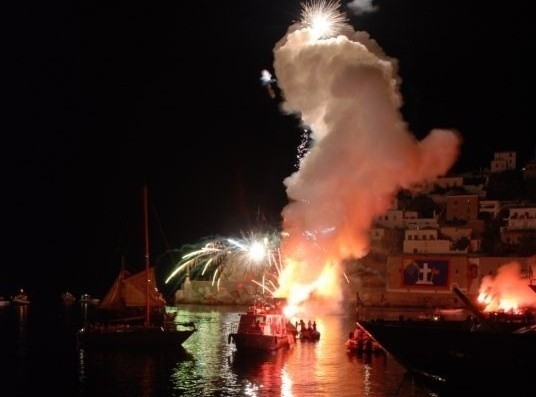
The “Happening,” the spectacular reenactment of the sinking by Miaoulis’s men of the Turkish flagship, featuring the siege and burning of an actual boat in the harbor and culminating in a spectacular fireworks display, takes place on Saturday, June 27. The harbor gets quite crowded, so be sure to get there early to find your viewing spot, be it a table at a cafe or perch on the hillside.
Hydra is famed for its Miaoulis Festival, or Miaoulia, commemorating Admiral Andreas Miaoulis, an important Hydriot naval commander in the Greek War of Independence (1821–1827), and his leadership in the Battle of Elder. The event closes with the “Happening,” a reinactment of the sinking by Miaoulis’s men of the Turkish flagship, featuring the siege and burning of an actual boat in the harbor and culminating in a spectacular fireworks display.
The preceding week of the festival includes a series of celebratory events, including boat races, folk dancing, athletic, artistic, and other cultural exhibitions, concerts, and the like.
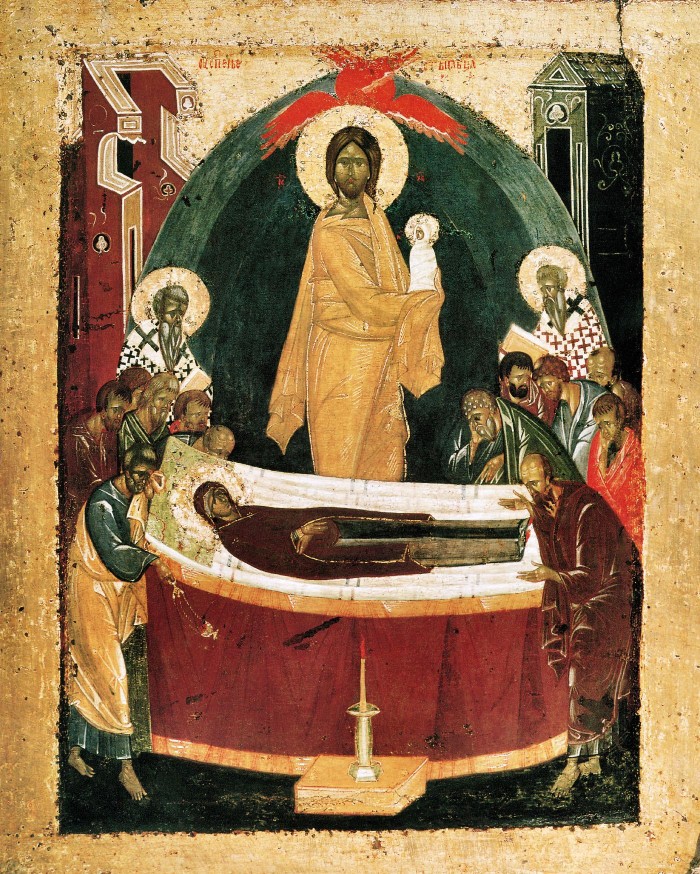
This great feasting day in the Greek Orthodox Church commemorates the “falling asleep,” or death, of Mary, the mother of Jesus, and her bodily resurrection before her ascent into heaven. The feast is preceded by a two-week fast, from August 1 to August 14, from red meat, poultry, meat products, dairy products (eggs and milk products), fish, oil, and wine.
March 25th regatta (courtesy Jacqueline Savidge)
Hydra hosts two annual three-day regattas that mark the beginning and end of the racing season. The first, held on the weekend before Independence Day, or March 25, is organized by the Hellenic Offshore Racing Club and heralds the beginning of the summer. The second, held on the weekend before Oxi Day, or October 28, is organized by the Historical Yacht Club of Greece.
Uploaded to YouTube by fonitisydras
Uploaded to YouTube by Κωνσταντίνος Κουκουδάκης
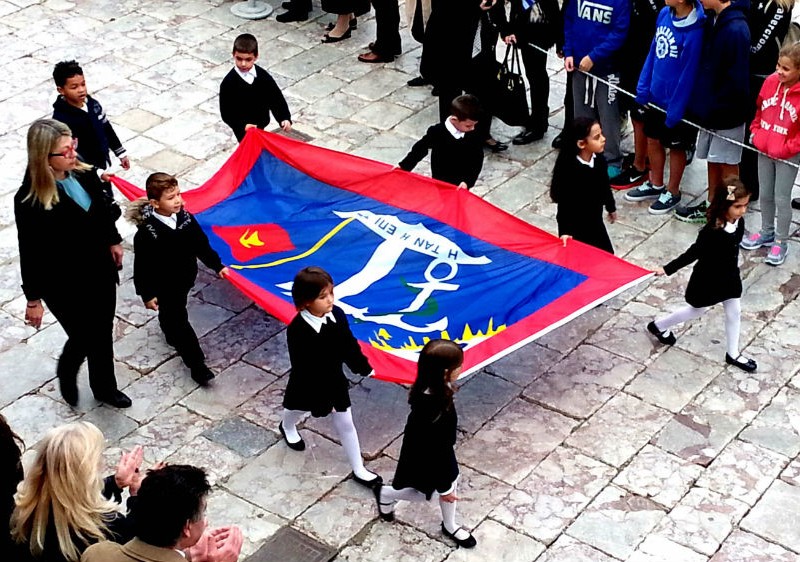
Oxi Day commemorates the rejection by Greek prime minister Ioannis Metaxas (r. August 4, 1936—January 29, 1941) of the ultimatum, made by Italian dictator Benito Mussolini on October 28, 1940, demanding that Greece allow Axis forces to enter Greek territory and occupy certain unspecified “strategic locations” or otherwise face war. Read more.
Photograph from Foni tis Ydras (http://fonitisydras.com/index.php/info/society/item/995-lampros_o_eortasmos_ths_ethnikhs_mas_epeteiou).
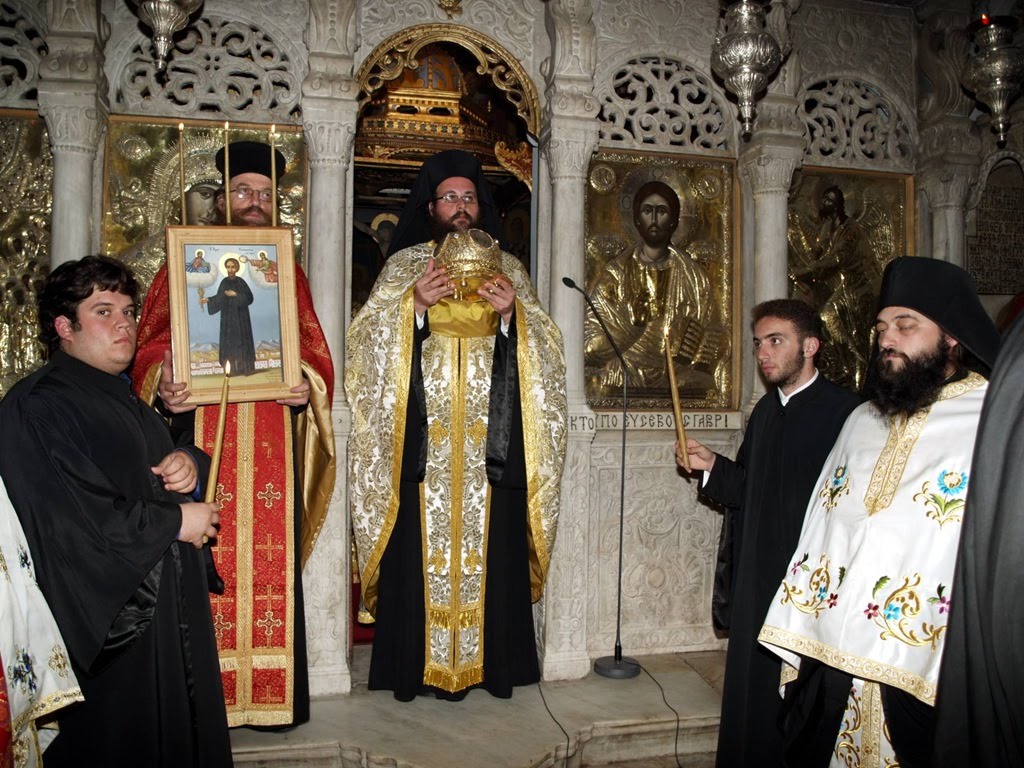 Born in 1770, Constantine the Hydriot, Hydra’s patron saint, was a neo-martyr from the period of the Turkish occupation of Greece. Constantine had converted to Islam when living in Rhodes, then later reverted to the Orthodox faith. The Turkish authorities imprisoned him for apostasy and hung him on November 14, 1800. He is celebrated on November 14 to huge feasting and fanfare on Hydra.
Constantine’s family lived in the Kiaffa area of Hydra. Today, the Cathdral of Konstantinos is built on the site of his birth. From the concrete terrace adjoining the church you can enjoy a stunning view of Kiaffa, over the roofs cascading down to the port and to Kamini, then across the harbor to the Peloponnese beyond.
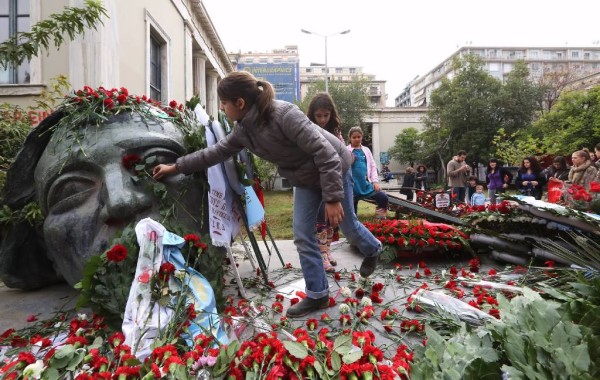 The Athens Polytechnic uprising in 1973 was a massive demonstration of popular rejection of the Greek military junta of 1967–1974. The uprising began on November 14, 1973, escalated to an open anti-junta revolt and ended in bloodshed in the early morning of November 17 after a series of events starting with a tank crashing through the gates of the Polytechnic.
November 17 is currently observed as a holiday in Greece for all educational establishments; commemorative services are held and students attend school only for these, while some schools and all universities stay closed during the day. The central location for the commemoration is the campus of the Polytechneio. The campus is closed on the 15th (the day the students first occupied the campus on 1973). Students and politicians lay wreaths on a monument within the Polytechneio on which the names of Polytechneio students killed during the Greek Resistance in the 1940s are inscribed. The commemoration day ends traditionally with a demonstration that begins from the campus of the Polytechneio and ends at the United States embassy.
The student uprising is hailed by many as a valiant act of resistance against the military dictatorship, and therefore as a symbol of resistance to tyranny. Others believe that the uprising was used as a pretext by Brigadier Dimitrios Ioannidis to put an abrupt end to the process of ostensible liberalisation of the regime undertaken by Spiros Markezinis.
From Wikipedia’s page “Athens Polytechnic uprising.”
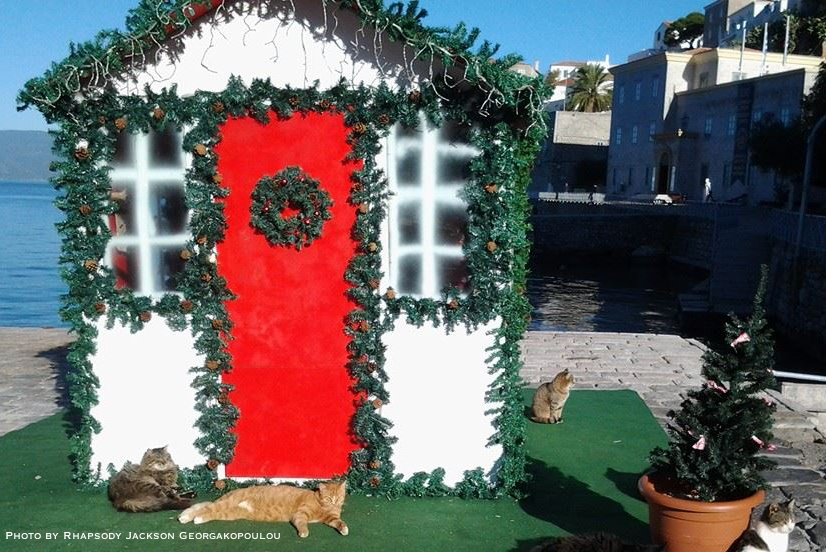
While not quite as prominent as Easter, or Pascha, Christmas is still an important holiday celebrated on Hydra, as witnessed by the festive lights and other decorations adorning the harbor, as well as lamp posts, railings, and shop and house windows throughout the town. Read about Christmas on Hydra.