


Recreation
Exploring Hydra by Foot or Boat
There are a number of hikes through along the coast or through the hills and mountains of Hydra, all of which provide stunningly beautiful scenery and views, as well as some pretty good exercise. Those seeking less vigorous recreation can pack a picnic lunch and take a boat trip around the island, stopping occasionally at various beaches and secluded bays for a swim. (more…)
A Guide to Hiking on Hydra | Focus on Hydra
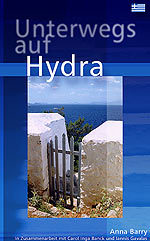
Guide to Hydra hikes
This website provides itineraries for twelve hikes around the island, some longer and more arduous, others short and sweet. Originally intended to be a book, published with gorgeous images of the Hydra landscape, the website provides access to useful hiking information and precautions, along with helpful photographs to help trekers find their way and recognize various points of interest.
According to its introduction, Focus on Hydra‘s “descriptions of the walks are punctuated by relevant architectural, historical and anecdotal information. Interviews with locals provide glimpses of Hydriote life and tradition. … The photos illuminate the island’s landscape and architecture, its people and animals, everything the appreciative wanderer wanderer may discover on his journey.” It’s well worth a peek! (more…)
About Kala Pigadia
Kala Pigadia (“Good Wells”) takes its name from two covered wells at the center of the neighborhood’s raised platia, or “square,” at the top of Miaoulis Street. Built in 1803 during the administration of Georgios Voulgaris, locals use them to this day to collect and carry fresh water, said to have a special quality, to their homes. Locals congregate on the benches by the wells to pass the time and share the latest news. (more…)
Beaches and Swimming on Hydra
Map of beaches on Hydra (click to enlarge)
Spilia | Avlaki | Kamini | Vlichos | Plakes | Molos | Bisti | Ayios Nikolaos | Limnioniza | Mandraki
Hydra has a variety of swimming spots and beaches, some close to town, some remote and secluded, accessible only by boat. In the descriptions below, all distances are approximated from Hydra Harbor. (more…)
Boat Picnics
Pack a picnic and hire a traditional fishing boat, or caique, and take a trip around Hydra Island, stopping at various secluded bays to swim in sparkling blue waters. Or spend the morning swimming off of Dokos, stop at a taverna on the mainland for lunch, and spend the afternoon swimming off the beaches and coves of the Peloponnese. Whichever route you chose, this is among the most peaceful ways to spend a day of your holiday on Hydra.
Byzantine or Ecclesiastical Museum of Hydra
Established in 1933 and located in the center of Hydra’s Harbor in the cathedral/town hall complex under the clock tower, this museum is a companion to Hydra’s cathedral itself. Housed in a former monk cell, exhibits include richly embroidered vestments, jewels, religious objects, and documents of historical value. There is a small admission fee (4 euros per person in 2010).
Hours (summer months): Tuesday to Saturday, 10 a.m. to 5 p.m. (Courtyard is always open.)
Cathedral of Hydra
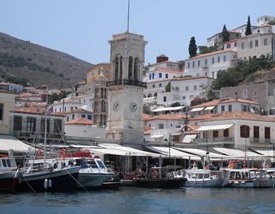
The cathedral is located behind the marble clock tower in the center of Hydra Harbor
Also called the Church of Dormition, the Monastery of the Assumption of the Virgin Mary, or “the Monastery,” Hydra’s main cathedral is located in the center of the harbor in the complex underneath the clock tower.
A nun is said to have arrived on Hydra in 1643 and built a church on this site dedicated to Saint Charalambos. She also built a few cloister cells for nuns. After these nuns died, monks took over the premisis. The original structure was destroyed in 1774 by an earthquake and rebuilt by Venetian architects. At this point, the edifice was renamed and dedicated to the Assumption of the Mother of God. (more…)
Church of Saint Konstantinos of Hydra | Kala Pigadia
Cathedral of St. Constantine the Hydriot
Convent of St. Evpraxia (at the Monestery of Profitas Ilias)
The Convent of St. Evpraxia is just 10 minutes’ walk from the Monastery of Profita Ilias. Facing the monastery’s entrance, walk to the right towards the threshing floor. As you turn right around the main monastery building, you’ll see a gate and a broad road leading to the convent.
While the convent grounds provide spectacular views of the island, its inner courtyard, planted with roses, has the peaceful atmosphere of a sanctuary. The convent’s chapel houses an icon of the saint reputed to have miraculous powers. The ossouary is the resting place of the remains of Iacovos Tombsis, Hydra’s first admiral
Gioni-Dokos built the Convent of Saint Evpraxia in 1808 for his daughter, a nun. While the convent is mostly shut these days, one nun still lives there and is often happy to have company, so don’t hesitate to knock.
The nameday of Saint Evpraxia is celebrated on July 25th.
Giorgios and Pavlos Koundouriotis Mansion (Museum of Modern History of Hydra)
Hydra shipowner Giorgios Kondouriotis
Located among the pine trees above the western side of Hydra’s harbor, the three-story Giorgios and Pavlos Koundouriotis Mansion houses heirlooms belonging to the Koundouriotis family and exhibitions about Hydra’s role in the Greek War of Independence and its nautical heritage. The manor complex consists of three buildings and a garden and is operated by the Greek Ministry of Culture as the Kountouriotis Family Museum and the Post-Byzantine Art and History Museum of Hydra. (more…)
Hydra Diving Center | Vlichos
A different view of Hydra
In Greece, scuba divers must be accompanied by a licensed guide by law, and Hydra Diving Center will take divers out both during the day and at night. Located in Vlichos, the center also provides scuba lessons, including to first-time divers. Equipment rental is available. For more information, visit the center’s website. (more…)
Hydra’s Historic Archives and Museum
The museum is located on the east side of Hydra Harbor, past the hydrofoil dock, heading toward the statue of Miaoulis
Founded in 1918, the Historic Archives and Museum of Hydra moved to its current, specially constructed location in 1972. Supervised by the Ministry of Education, the archives gathers and catalogs all documents related to Hydra, particularly the history, culture, and tradition of the island. Today the collection includes some 20,000 original manuscripts, codices books, and other historic rare documents and materials. The museum displays artifacts from national and Hydriot history and culture, as well as paintings by well-known artists. (more…)
Hydra’s Architecture
Stone windmills, some in ruins, dot the hillsides, and the town and surrounding villages are home to more than 350 churches and chapels. Hydra’s status as a national historic landmark protects its unique and beautiful architecture. Any new buildings must stay in keeping with the island’s historic architectural style, using authentic colors and maintaining the traditional Hydriot character. As a result, no modern building developments (high-rise apartments, hotel complexes) can spoil Hydra’s traditional atmosphere. In addition to cars and mopeds, neon signs have been banned. Hydra’s architecture, which includes simple houses as well as grand manors, is unique to the island. (more…)
Hydra’s Historic Mansions
Mansions (Archontika)
The mansions and manors of Hydra have a history and architecture unique to the island. As most of these structures are still owned by private families, many are not open to the public. Some, however, now house public services are open to visitors. (more…)
Lazaros Koundouriotis Mansion (National Historical Museum)
Lazaros Kondouriotis
Called the “Father of the Nation,” Lazaros Koundouriotis was great shipowner who played an important role in the Greek War of Independence. Located near Hydra’s port, the archontika, or manor, of Lazaros Koundouriotis provides a superb example of the eighteenth-century Hydriot mansions facing the harbor, whose architecture often reflects influences from abroad. Built in 1780, it was donated to the Historic-Ethnologic Institute of Greece by the family’s descendants and today operates as a branch of the National Museum of History. (more…)
Monastery of Agia Triada (Holy Trinity) | Mandraki
Located in the hills above Mandraki, the Monastery of Agia Triada (Holy Trinity), an example of the simple and austere monastic style of architecture.
Agia Triada is thought to have been founded in 1704 by Antonios Oikonomou, a priest and the grandfather of a naval captain who initiated the Greek Revolution against the Turks on Hydra. Originally a convent for nuns, it was later transformed into an monks’ monastery, which is only accessible to male visitors on one day of the year. During the Revolution of 1821, the monastery contributed financially to the Greek cause, and in 1825, Greek revolutionaries fortified the building against possible attack.
Agia Triada has undergone renovations in 1915, after a severe thunderstorm destroyed the dome and roof of the katholikon, and between 1970 and 1974. The katholikon of the monastery is located in the centre of the yard, surrounded by cells, a world-famous library, a dining room, and other buildings.
For directions for how to hike to Agia Triada, see Focus on Hydra, Hike 4. The walk should take less than an hour.
Off-Island Excursions
Use Hydra as your base to visit the various points of cultural and historical interest in the surrounding areas, either on neighboring islands or the Peloponnese. (more…)
Open Air Cinema | Hydra Town
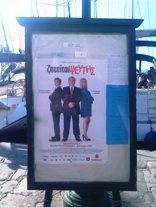 The open air cinema in Hydra Town, located on Oikonomou Street, shows a variety of Greek, English-language, and foreign films on Monday and Tuesday nights during the summer. Show times are at 9 p.m. and 11 p.m. Notice boards around town and on the port advertise the month’s schedule.
Hydra’s Cinema Club also hosts excursions to the mainland to attend plays performed at the ancient theater of Epidavros. See the boards around town or call for more information. (more…)
Prophet Ilias Monastery (Μοναστήρι του Προφήτης Ηλίας)
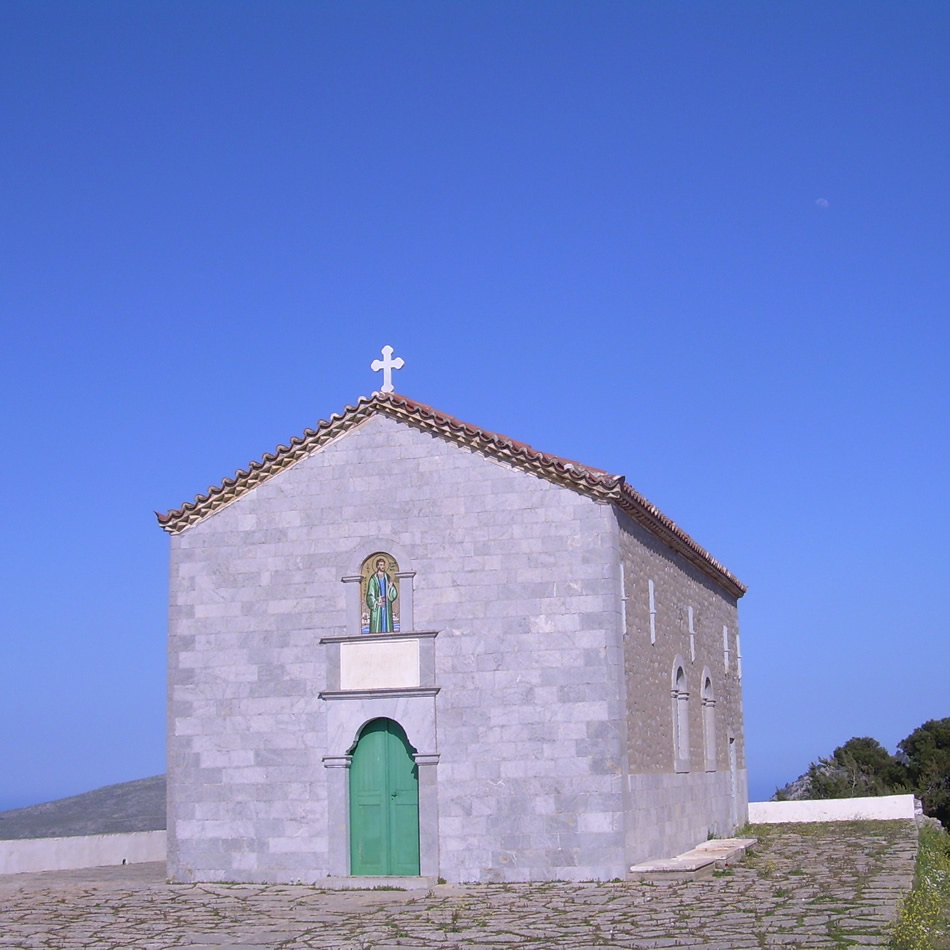 Nestled at an altitude of 500 meters into a slope of Mount Eros, Hydra’s highest peak, and a good two hours’ hike above Hydra Town, depending on your pace, the Monastery of Prophet Elias provides spectacular views of the island, sea, and Peloponnese. Built in 1813 by the monk Ierotheos on the site of an abandoned monastery, the grounds are today cared for by a small community of monks and include a courtyard enclosing the main church, other attractive buildings, stables, and a vegetable garden. The monastery played a significant role in Greek history, as revolutionary hero Kolokotronis was imprisoned here during the revolt against the Ottoman Empire. (more…)
Space DVD Club | Hydra Town

Space DVD storefront
Bring your passport and sign up to rent DVDs for €3 apiece. New releases are rented overnight; older DVDs are rented for 3 nights at a time. Late fees are €1 per night.
Contact:
22980 52640
Summer stretching and Pilates classes
During the summer months, on Monday, Wednesday, and Friday, an hour-long class is offered at the Bratsera Hotel, starting at 10 a.m. The cost is €8 per person. For more information, contact the Bratsera.
Tombazis Manor (School of Fine Art)
Housed in the four-storey Tombazis Mansion since 1936, the School of Fine Art exhibits paintings of historical ships and events. Well-known Greek painter Periklis Vizantios (1893–1971) assisted with the school’s opening, and Mark Chagall once lived for a time in this mansion when he taught at the school.
Now owned by the University of Athens, the building is open only to the school’s students, though visitors may take a peek inside when the school is open.
Tsamados Mansion (School of the National Merchant Marine)
Located on the eastern side of Hydra’s port next to the Hydra Historic Archives and Museum and built between 1780 and 1810, the Tsamados Mansion houses the National Merchant Marine School, which has operated continuously since its founding in 1749. In 1930, the school moved to its current location.
Anastasios Tsamados, a heroic admiral, was killed during the Greek Revolution (1821). The manor was later home to Athanasios Koulouras, a benefactor of Hydra.
Though not allowed inside the building, visitors can view the impressive exterior.
Yoga on Hydra
Hydra does not have its own yoga studio, but there are morning pilates/stretching classes available at the Bratsera Hotel during the summer. Contact the Bratsera for details. (more…)