


Sights
Byzantine or Ecclesiastical Museum of Hydra
Established in 1933 and located in the center of Hydra’s Harbor in the cathedral/town hall complex under the clock tower, this museum is a companion to Hydra’s cathedral itself. Housed in a former monk cell, exhibits include richly embroidered vestments, jewels, religious objects, and documents of historical value. There is a small admission fee (4 euros per person in 2010).
Hours (summer months): Tuesday to Saturday, 10 a.m. to 5 p.m. (Courtyard is always open.)
Cathedral of Hydra
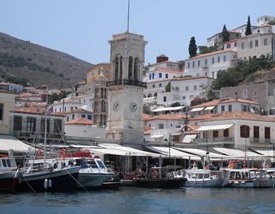
The cathedral is located behind the marble clock tower in the center of Hydra Harbor
Also called the Church of Dormition, Monastery of the Assumption of the Virgin Mary, or “the Monastery,” Hydra’s main cathedral is located in the center of the harbor in the complex underneath the clock tower.
Originally constructed in the mid-1600s and rebuilt in 1750 by Venetian architects following an earthquake, this Byzantine-style cathedral with its two marble bell towers consists of a three-laned, pillared basilica with cupola and a marble temple. Its magnificent interior includes a marble iconostasis, hundreds of gold and silver icons, and other elaborate Orthodox decoration. (more…)
Giorgios and Pavlos Koundouriotis Mansion
Hydra shipowner Giorgios Kondouriotis
Located among the pine trees above the western side of Hydra’s harbor, the three-story Giorgios and Pavlos Koundouriotis Mansion houses heirlooms belonging to the Koundouriotis family and exhibitions about Hydra’s role in the Greek War of Independence and its nautical heritage. The manor complex consists of three buildings and a garden and is operated by the Greek Ministry of Culture as the Kountouriotis Family Museum and the Post-Byzantine Art and History Museum of Hydra. (more…)
Hydra’s Historic Archives and Museum
The museum is located on the east side of Hydra Harbor, past the hydrofoil dock, heading toward the statue of Miaoulis
Founded in 1918, the Historic Archives and Museum of Hydra moved to its current, specially constructed location in 1972. Supervised by the Ministry of Education, the archives gathers and catalogs all documents related to Hydra, particularly the history, culture, and tradition of the island. Today the collection includes some 20,000 original manuscripts, codices books, and other historic rare documents and materials. The museum displays artifacts from national and Hydriot history and culture, as well as paintings by well-known artists. (more…)
Hydra’s Architecture
Stone windmills, some in ruins, dot the hillsides, and the town and surrounding villages are home to more than 350 churches and chapels. Hydra’s status as a national historic landmark protects its unique and beautiful architecture. Any new buildings must stay in keeping with the island’s historic architectural style, using authentic colors and maintaining the traditional Hydriot character. As a result, no modern building developments (high-rise apartments, hotel complexes) can spoil Hydra’s traditional atmosphere. In addition to cars and mopeds, neon signs have been banned. Hydra’s architecture, which includes simple houses as well as grand manors, is unique to the island. (more…)
Hydra’s Historic Mansions
Mansions (Archontika)
The mansions and manors of Hydra have a history and architecture unique to the island. As most of these structures are still owned by private families, many are not open to the public. Some, however, now house public services are open to visitors. (more…)
Lazaros Koundouriotis Mansion (National Historical Museum)
Lazaros Kondouriotis
Called the “Father of the Nation,” Lazaros Koundouriotis was great shipowner who played an important role in the Greek War of Independence. Located near Hydra’s port, the archontika, or manor, of Lazaros Koundouriotis provides a superb example of the eighteenth-century Hydriot mansions facing the harbor, whose architecture often reflects influences from abroad. Built in 1780, it was donated to the Historic-Ethnologic Institute of Greece by the family’s descendants and today operates as a branch of the National Museum of History. (more…)
Prophet Elias Monastery (Μοναστήρι του Προφήτης Ηλίας)
Prophet Elias Monastery viewed from Hydra's port
Between one and two hour’s walk above Hydra Town, depending on your pace, the Monastery of Prophet Elias provides spectacular views of the island, sea, and Peloponnese. Built in 1813 on the slope of Mount Eros on the site of an abandoned monastery, the grounds are today cared for by two monks and include a courtyard enclosing the main church, other attractive buildings, stables, and a vegetable garden. (more…)